

Hey friends, Pip the dragon here! 🐉 I love shiny new gadgets as much as I love a warm pile of gold. But not every gadget gets a happy ending. Some of the biggest companies in the world (Google, Microsoft, Samsung, Amazon) have launched products that flopped, and some of them flopped hard.
Today we're looking at 5 tech products that failed badly, what went wrong with each one, and the simple lessons hiding inside every flop. Grab a snack, because one of these involves juice. 🧃
Quick Summary: The 5 Flops at a Glance
| Product | Launched | What went wrong | How it ended |
|---|---|---|---|
| Google Glass (Explorer Edition) | 2013 | $1,500 price, privacy worries | Sales to individuals ended Jan 2015 |
| Microsoft Zune | 2006 | Arrived late to an iPod world | Hardware discontinued Oct 2011 |
| Juicero | 2016 | $699 juicer you didn't really need | Price cut to $399, shut down 2017 |
| Samsung Galaxy Note 7 | 2016 | Batteries that could catch fire | Global recall, banned on US flights |
| Amazon Fire Phone | 2014 | Pricey, not much reason to switch | $170M write-down |
1. Google Glass: Too Early, Too Pricey, Too Creepy?
What it was
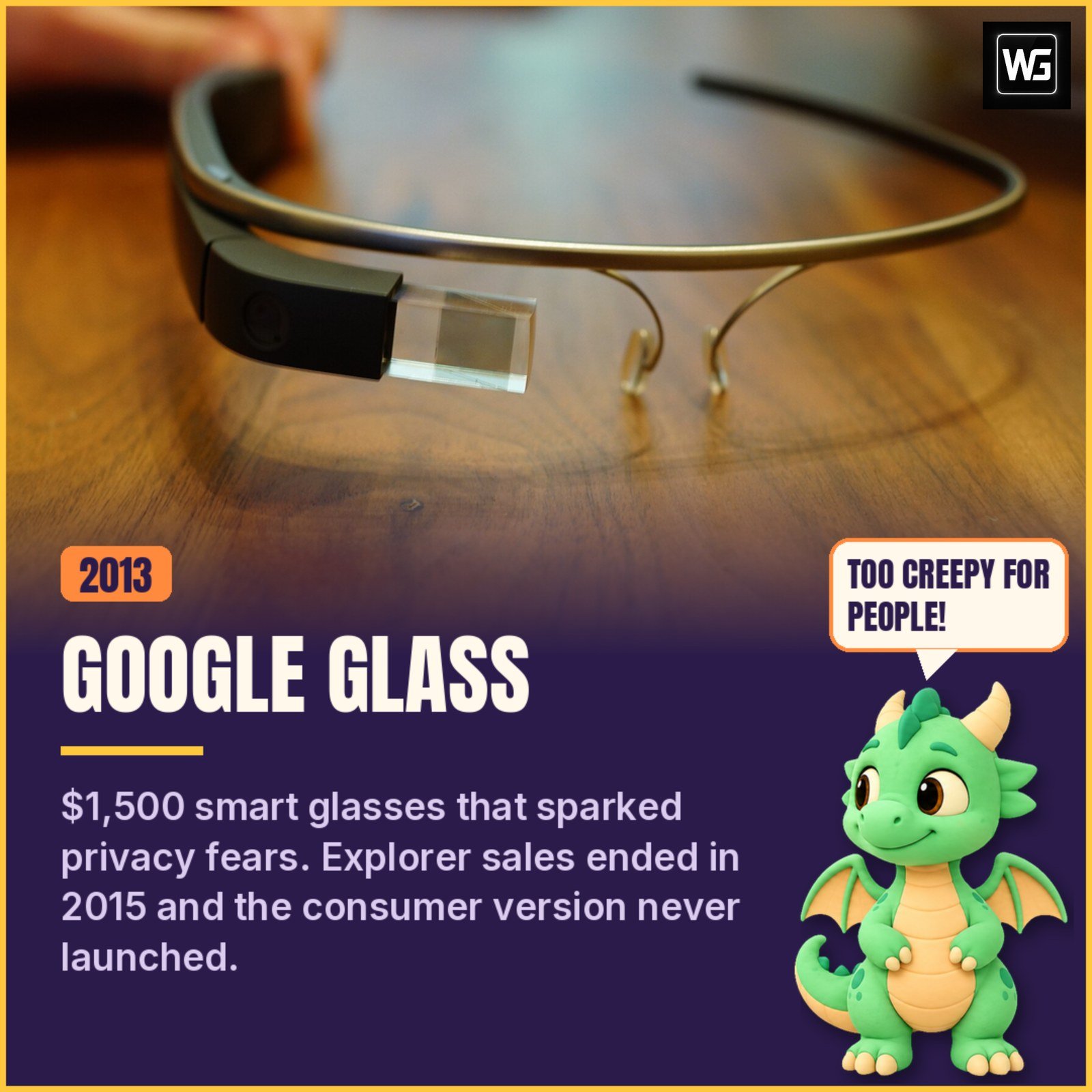
Google Glass was a pair of smart glasses with a tiny screen sitting just above your eye. It could take photos, give directions and answer search questions. The Explorer Edition first went out in April 2013 to people in Google's "Explorer" program, at a price of $1,500 (ABC News). In May 2014 Google opened sales to anyone in the US, still at $1,500 (TechCrunch).
Why it failed
- Price: $1,500 is a lot of money for a gadget that does less than your phone.
- Privacy concerns: People didn't love being near someone whose glasses might be recording them. Glass was even banned in some public places, and wearers picked up the unkind nickname "Glassholes" (ABC News).
- No clear "why": Most people couldn't explain what it was for.
How it ended
Google closed the Explorer program, and January 19, 2015 was the last day individuals could buy Glass Explorer Edition (The Verge; BBC News). Google said a consumer version would come later, but a mainstream consumer Glass never launched. Business programs carried on for a while (9to5Google).
Pip's lesson: 🐉 Cool tech isn't enough. People need to feel comfortable around it, too.
2. Microsoft Zune: The iPod Rival That Never Caught Up
What it was
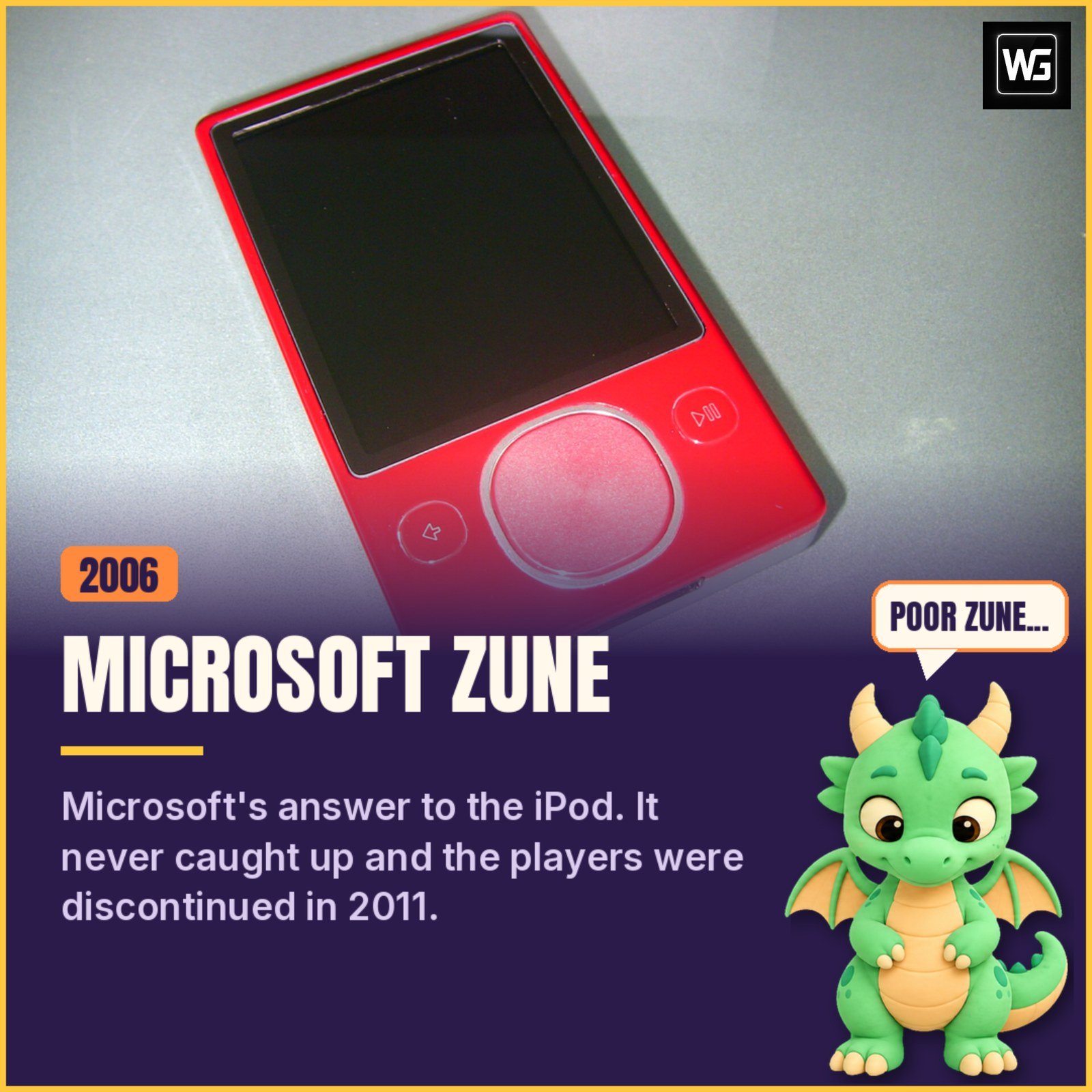
The Zune was Microsoft's music player, built to take on Apple's iPod. It launched in the US on November 14, 2006 for $249.99, with a 30GB drive and wireless song sharing between Zunes (Microsoft).
Why it failed
- Late to the party: By 2006 the iPod was already the music player. Being "almost as good" didn't give people a reason to switch.
- A bumpy first version: Early reviews said some basic features felt "crippled or poorly implemented" (Ars Technica).
- Smartphones arrived: Phones started doing music too, so standalone players began to fade.
How it ended
In October 2011, Microsoft confirmed it would stop making Zune players and focus on Windows Phone instead (The Verge). The Zune name hung around on Microsoft's music and video services until 2012 (Wikipedia).
Pip's lesson: 🐉 Copying the leader rarely beats the leader. You need something truly different.
3. Juicero: The $699 Juicer You Could Beat With Your Hands
What it was
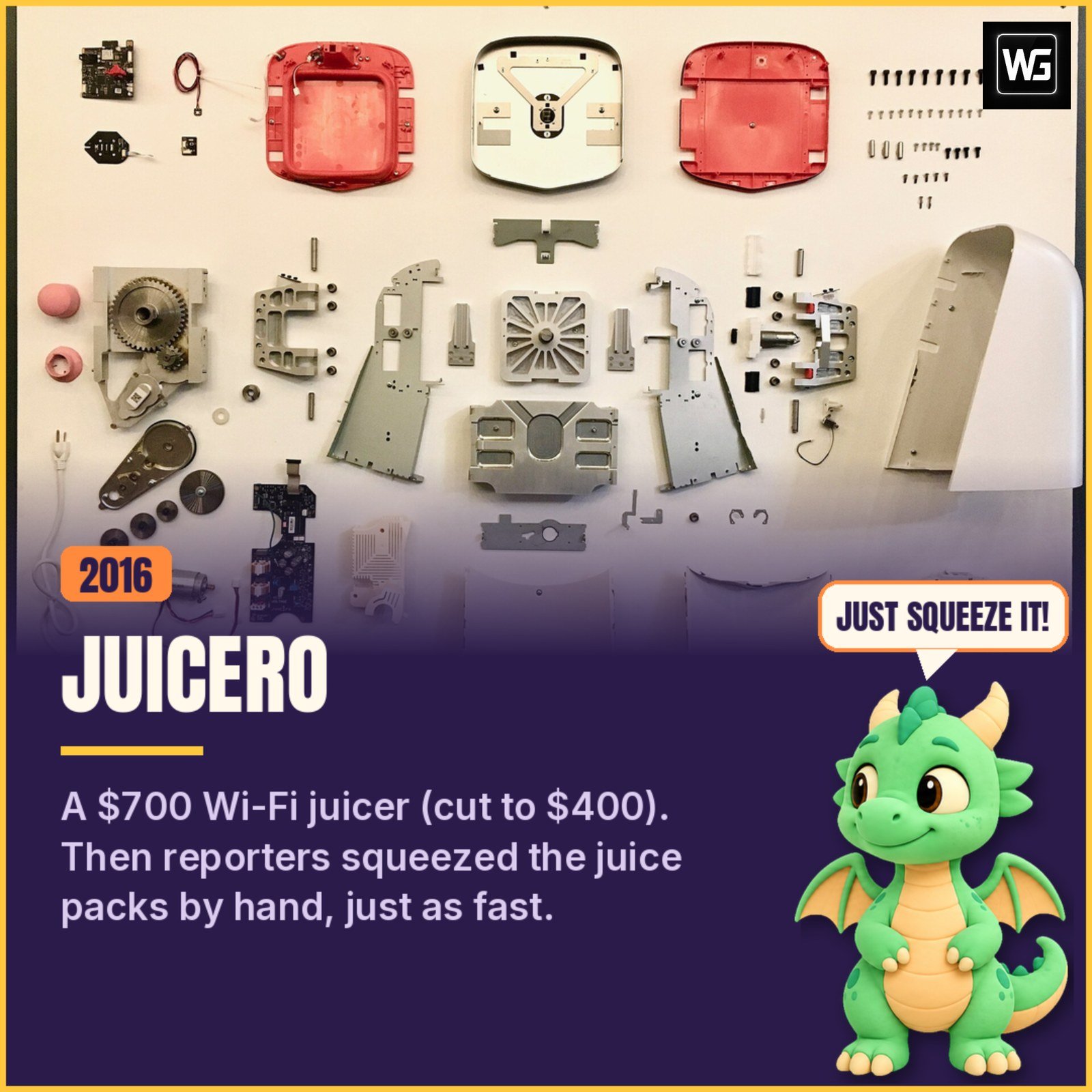
Juicero was a Wi-Fi-connected juicer that squeezed juice out of special pre-packed bags of chopped fruit and veg. It launched in 2016 at $699 (Fortune). It only worked with Juicero's own packs, which cost around $5 to $7 each.
Why it failed
- Price: In January 2017 Juicero cut the price from $699 to $399 (The Verge). Still a lot for a juicer.
- The hand-squeeze moment: In April 2017, Bloomberg reporters showed you could squeeze the packs by hand. They got 7.5 ounces of juice by hand in about 90 seconds, compared with 8 ounces from the machine in about two minutes (Ars Technica; The Verge).
- Over-engineering: A fancy machine was solving a problem that barely existed.
How it ended
Juicero offered customers refunds (Bloomberg) and shut down in September 2017 (CNBC).
Pip's lesson: 🐉 If your product can be replaced by two hands, it's time to rethink the product.
4. Samsung Galaxy Note 7: The Phone That Got Too Hot
What it was
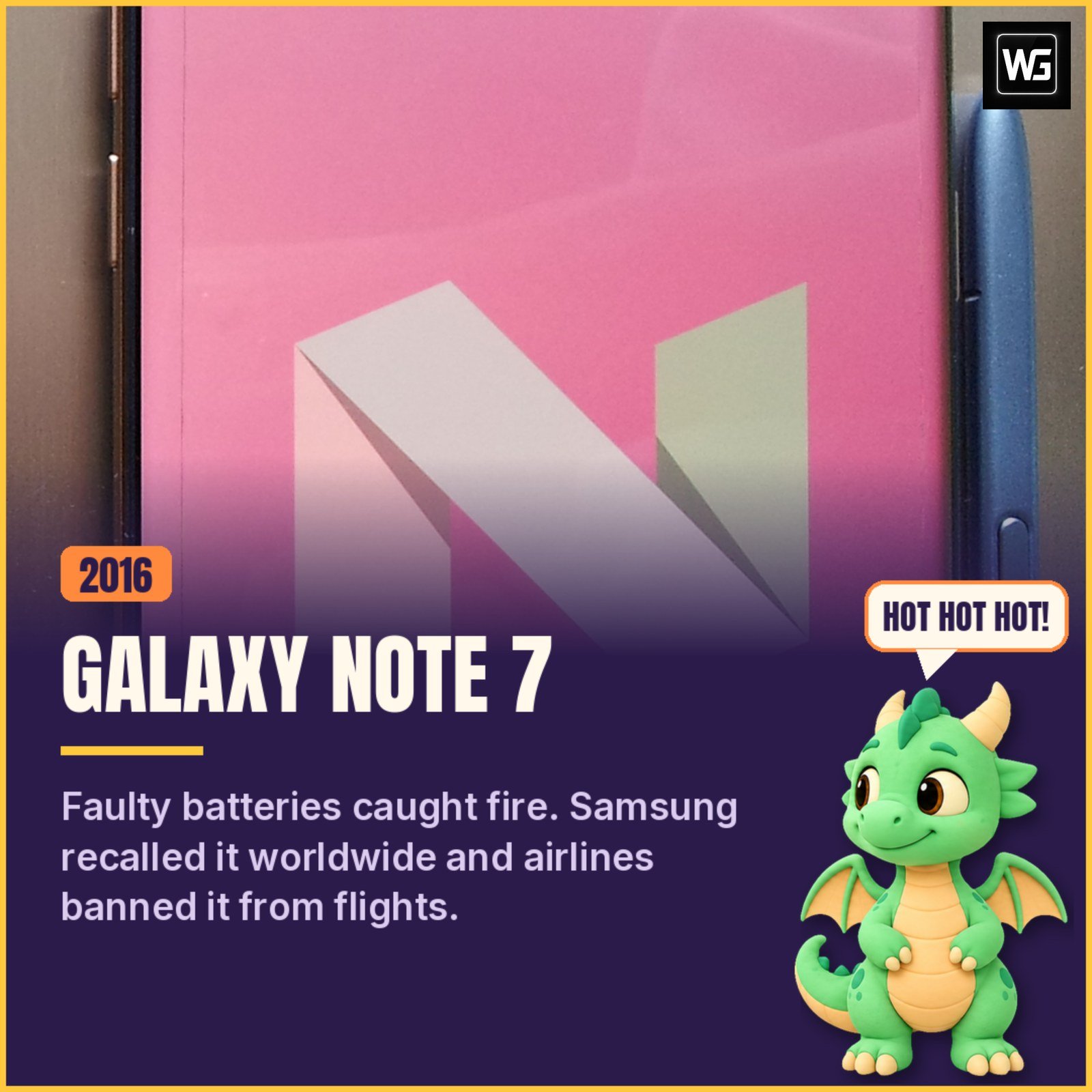
The Galaxy Note 7 was Samsung's big-screen flagship from August 2016, selling in the US for about $850 to $890 (CPSC). Reviewers liked it. Then the problems started.
Why it failed
- Battery fires: The lithium-ion battery could overheat and catch fire. In the US alone, Samsung got 92 reports of overheating, including 26 burns and 55 cases of property damage (CPSC).
- The replacements had problems too: Samsung announced a global recall on September 2, 2016 (Reuters), but some replacement phones overheated as well. One Southwest Airlines plane was evacuated after a Note 7 started smoking on board (Reuters timeline).
How it ended
On October 11, 2016, Samsung stopped making and selling the Note 7 for good. US regulators then banned every Note 7 from US flights (carry-on, checked bags and air cargo) starting October 15, 2016 (US DOT). Airlines around the world brought in their own bans.
Pip's lesson: 🐉 Safety beats speed. Rushing a product out can cost far more than waiting.
5. Amazon Fire Phone: A Shopping Mall in Your Pocket
What it was
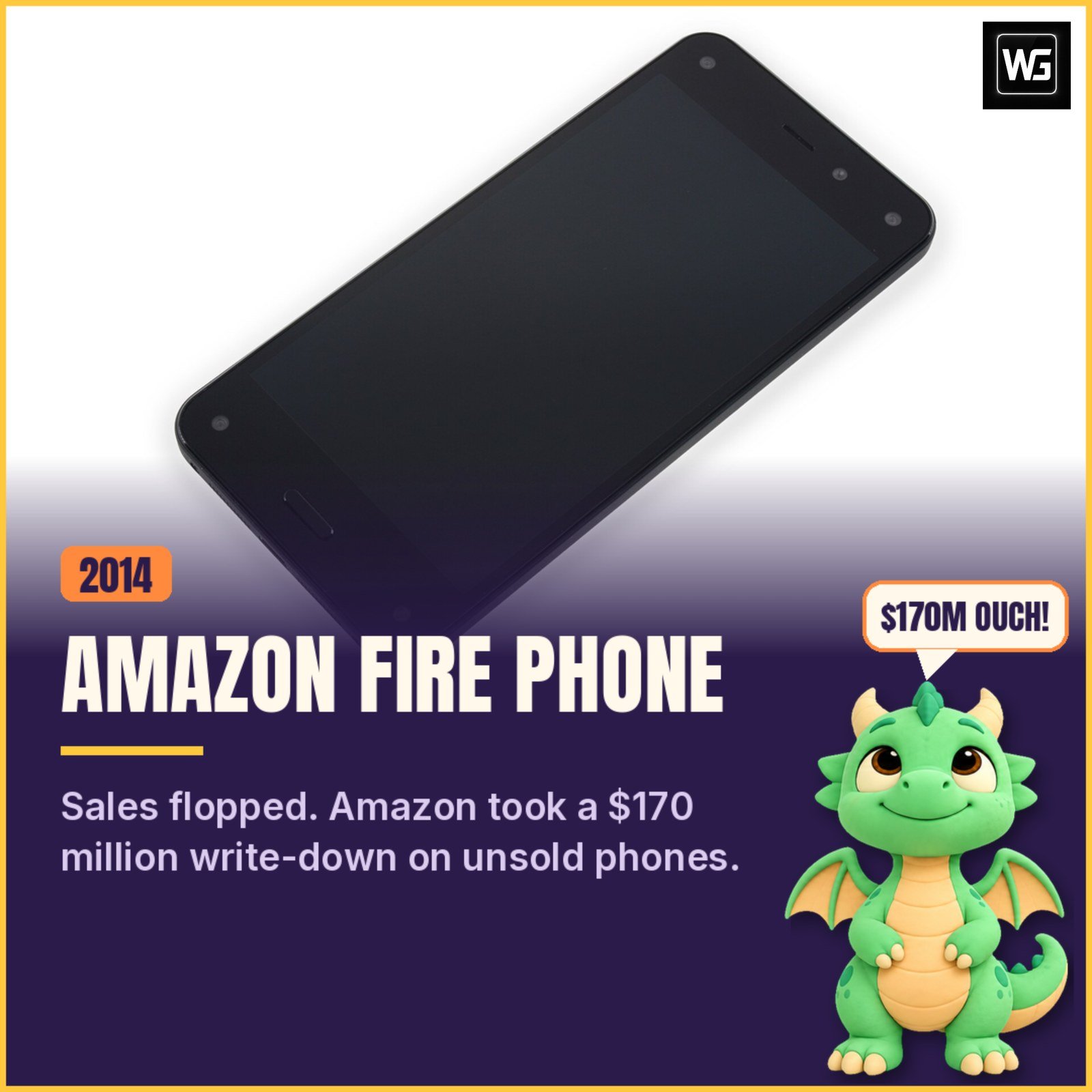
Amazon's Fire Phone launched in July 2014, only on AT&T, at $199 with a two-year contract. Its big trick was "Dynamic Perspective," a 3D effect driven by cameras that tracked your face (Forbes).
Why it failed
- Flagship price, few reasons to buy: It cost about as much as an iPhone or Galaxy but did less (The Guardian).
- Too focused on shopping: It often felt built to sell you Amazon stuff more than to be a great phone (TechCrunch).
- Weak sales: Estimates put sales at about 35,000 in the first few weeks (GeekWire).
How it ended
Amazon cut the price to just 99 cents on contract. Then in October 2014 it took a $170 million charge, mostly for Fire Phone inventory and supplier costs, and still had about $83 million worth of unsold phones sitting in warehouses (GeekWire; WIRED).
Pip's lesson: 🐉 Build for the user first. A product that mostly serves the company gets found out quickly.
What These Tech Flops Have in Common
Put all five side by side and a few patterns jump out:
They didn't solve a real problem
Juicero and Google Glass both had a hard time answering "why do I need this?"
The price didn't match the value
$1,500 glasses, a $699 juicer and a flagship-priced Fire Phone all asked for a lot of money before they'd earned trust.
Timing and trust matter
The Zune showed up too late. The Note 7 lost people's trust over safety, and that's very hard to win back.
The good news: Failure often feeds the next success. Samsung added tougher battery checks, and smart glasses are making a comeback today. Flops are part of how tech grows up.
FAQ: Failed Tech Products
What is the biggest tech product failure of all time?
There's no official ranking, but the Samsung Galaxy Note 7 is one of the most famous. It ended in a global recall and a US ban on flights because its batteries could catch fire (US DOT).
Why did Google Glass fail?
Glass cost $1,500, raised privacy concerns because it could record people, and didn't have a clear everyday use. Google ended sales to individuals in January 2015 (BBC News).
When was the Microsoft Zune discontinued?
Microsoft stopped making Zune players in October 2011 and moved its focus to Windows Phone (The Verge).
What happened to Juicero?
Juicero launched at $699, cut its price to $399 in 2017, and shut down that September after reporters showed its juice packs could be squeezed by hand (CNBC).
How much money did Amazon lose on the Fire Phone?
Amazon took a $170 million charge in 2014, mostly for unsold Fire Phone inventory and supplier commitments (GeekWire).
Conclusion: Even Giants Stumble
Google, Microsoft, Samsung and Amazon are some of the smartest companies on the planet, and they still got it wrong. The lesson isn't "don't try new things." It's to solve a real problem, price it fairly, and earn people's trust.
Which flop surprised you most? Tell Pip! 🐉
👉 Follow us on Instagram for bite-sized tech news explained simply, starring Pip the dragon. New posts every week, with no jargon and lots of fun. Follow on Instagram: instagram.com/wireglobally
Photo credits: Loic Le Meur CC BY 2.0 (hook); Ted Eytan CC BY-SA 2.0 (Glass); Robert Nelson CC BY 2.0 (Zune); Steve Jurvetson CC BY 2.0 (Juicero); Pang Kakit CC BY-SA 4.0 (Note 7); Frmorrison CC BY-SA 3.0 (Fire Phone). Photos via Wikimedia Commons.


[…] Pip’s take: 🐉 This is a science experiment, not a product (yet). But every big idea starts with one small, brave test. (Moonshots don’t always work, though: read about tech products that failed.) […]