

Pip here! 🐉 Dragons are used to flying high, but this time Google has gone a lot higher than me. On October 1, 2026, Google sent its own AI chips into orbit on a small satellite. It’s the first real test of a big “moonshot” idea called Project Suncatcher: could future AI data centers float in space and run on sunlight?
In this post I’ll explain what launched, why Google wants to build computers in space, the big problems still in the way, and what’s coming next. No rocket science degree needed. Well, maybe a little. 🚀
What Is Google’s Project Suncatcher?
Project Suncatcher is a long-term Google research project that asks whether space could one day host large-scale machine learning infrastructure, meaning the giant computers that train and run AI (Google). Google first revealed the idea in November 2025 (CNBC).
The big dream is this: instead of building ever-bigger data centers on Earth, put clusters of solar-powered satellites in orbit. They’d be packed with AI chips and talk to each other using lasers.
Project lead Travis Beals calls the whole thing a “moonshot,” and says it’s “going to take a long time” (NPR).
What Actually Launched on October 1, 2026?

The rocket and the ride
The prototype went up on SpaceX’s Transporter-18 rideshare mission, a Falcon 9 rocket that carried lots of satellites at once, launching from Vandenberg in California (CNBC). Google says it has confirmed contact with the satellite and that it’s “operating as expected” (Google).
The satellite
- Size: About as big as a refrigerator (NPR; Ars Technica).
- Built with Planet: The satellite imagery company Planet helped develop the satellite. Google supplied the AI hardware inside (NPR).
- Brains: Four Google TPUs (Tensor Processing Units), the same kind of custom AI chips Google uses in its data centers on Earth (Ars Technica).
- Power: Solar panels that supply only about 1 kilowatt, roughly what a microwave or hair dryer uses (Ars, citing The New York Times). The prototype also carries batteries and sits in a standard orbit. NPR corrected its story to say the battery-free, sun-synchronous orbit design is planned for future satellites (NPR).
What’s a TPU, simply?
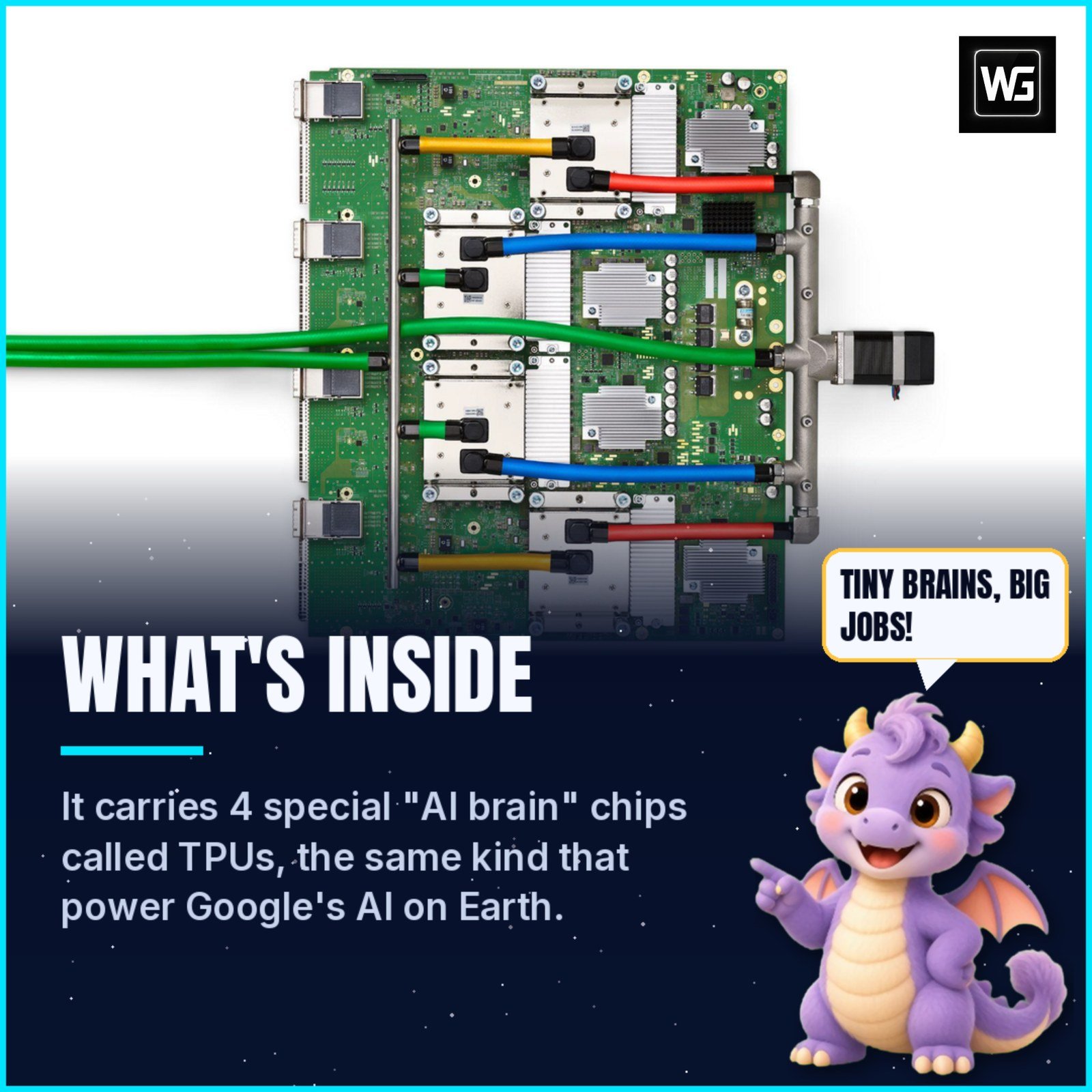
Think of a TPU as a chip built for one job: doing AI math really fast. Your laptop’s processor can do a bit of everything. A TPU is the specialist. 🧠
Why Put AI Data Centers in Space?
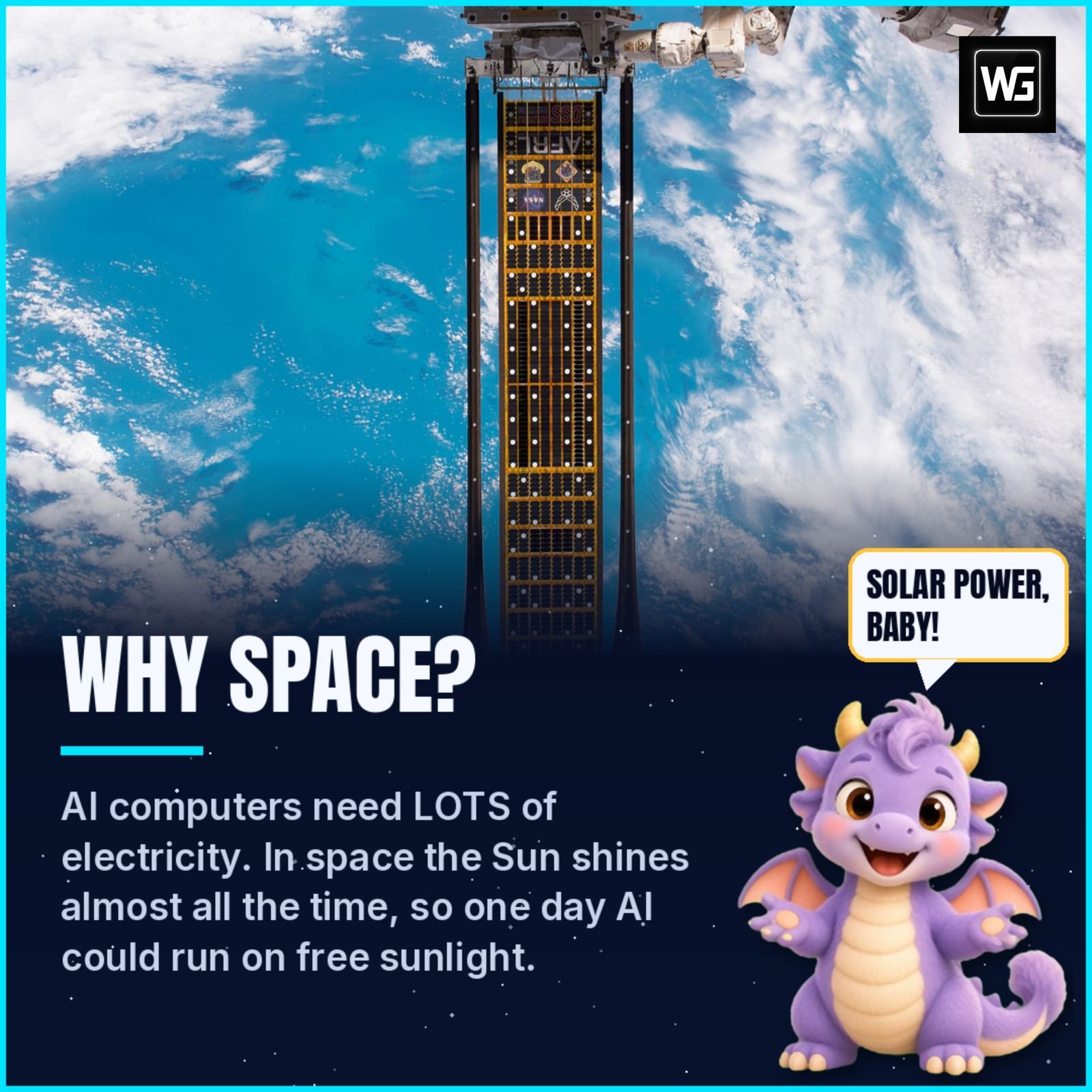
1. The Sun is the ultimate power source
AI uses a lot of electricity. Beals put it this way: “The sun puts out almost all of the power in our solar system,” and every other power source humanity uses is “just a tiny fraction of a percent” (NPR).
2. More sunlight up there
Google says satellites in low Earth orbit can get near-constant sunlight, “generating up to eight times more solar power than on Earth” (CNBC). No clouds, no night (in the right orbit), and no weather.
3. AI demand is exploding
Google CEO Sundar Pichai has said demand for AI services is bigger than supply. He expects Google to spend $180 to $190 billion this year, much of it on computing infrastructure (NPR).
4. Pushback on Earth
Big, power-hungry data centers are facing more and more local opposition. Space offers lots of room and no neighbors, although it brings its own headaches (NPR).
The Big Problem: Keeping Chips Cool in Space
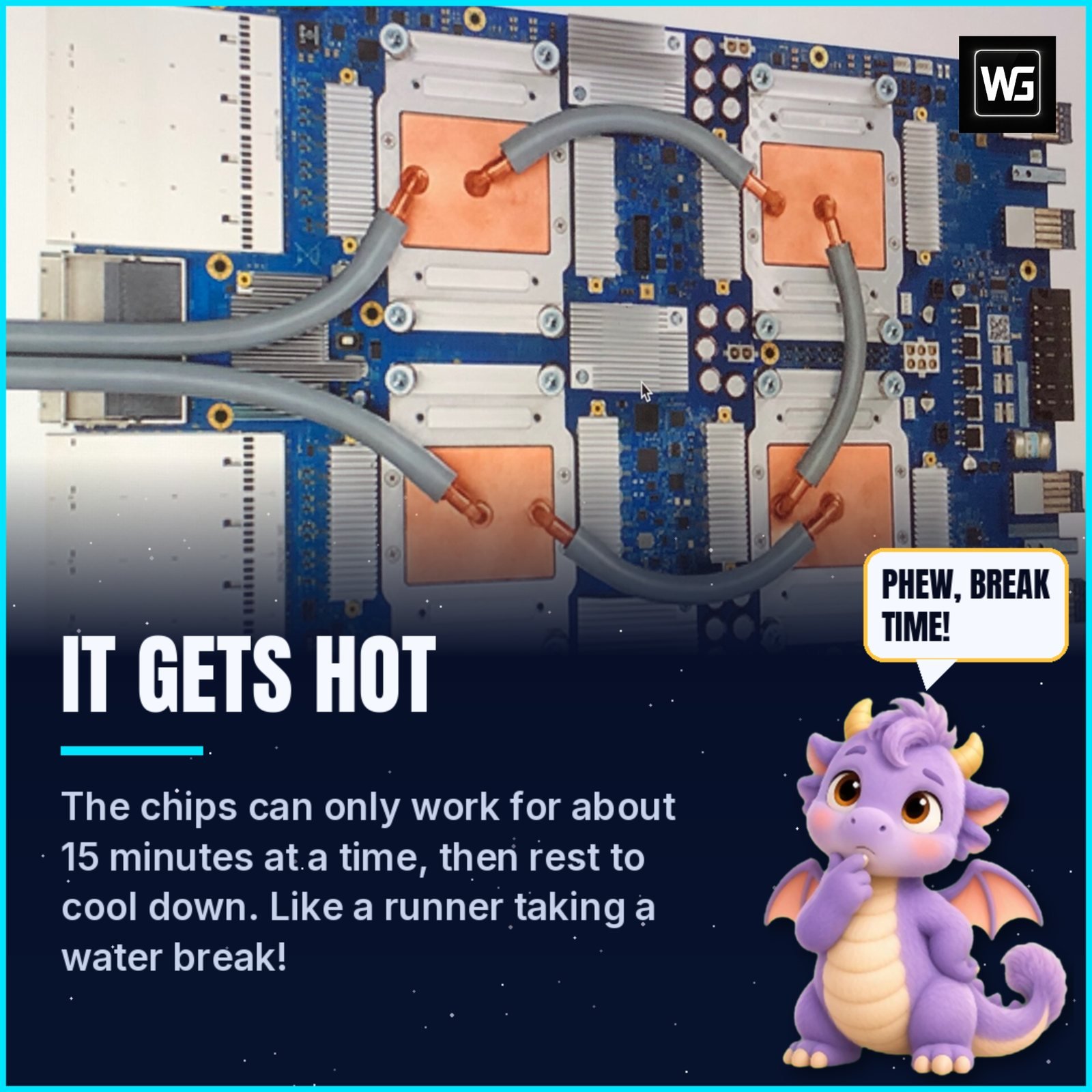
Why heat is so hard up there
On Earth, we cool computers with fans, air and water. Space is a vacuum, so there’s no air to carry heat away (NPR).
Google’s solution (for now)
Google connects the chips to aluminum and copper heat pipes through a squishy “thermal interface material.” The pipes carry heat to a radiator that sends it out into space as infrared light (Ars Technica).
The 15-minute rule ⏱️
The cooling system can’t keep up forever. The TPUs run for about 15 minutes at a time, then shut down so the radiators can catch up (Ars Technica; NPR). While they’re on, they’ll run a Google AI model to answer simple questions.
Beals also says the radiators are among the heaviest parts of the satellite. That matters, because heavier means more expensive to launch (NPR).
What Is Google Testing?
Google says that over the coming weeks it will collect data on how its TPUs handle “the physical stress of spaceflight and the radiation and thermal extremes of space” (Google). That includes:
- Radiation: It can damage chips or “flip bits,” which messes up calculations.
- Launch shaking: Vibration and high g-forces on the way up.
- Temperature swings: Can the cooling setup actually work in orbit?
Google has also published a peer-reviewed paper about the research in the journal Joule (Google).
What’s Next: Two More Satellites in 2027
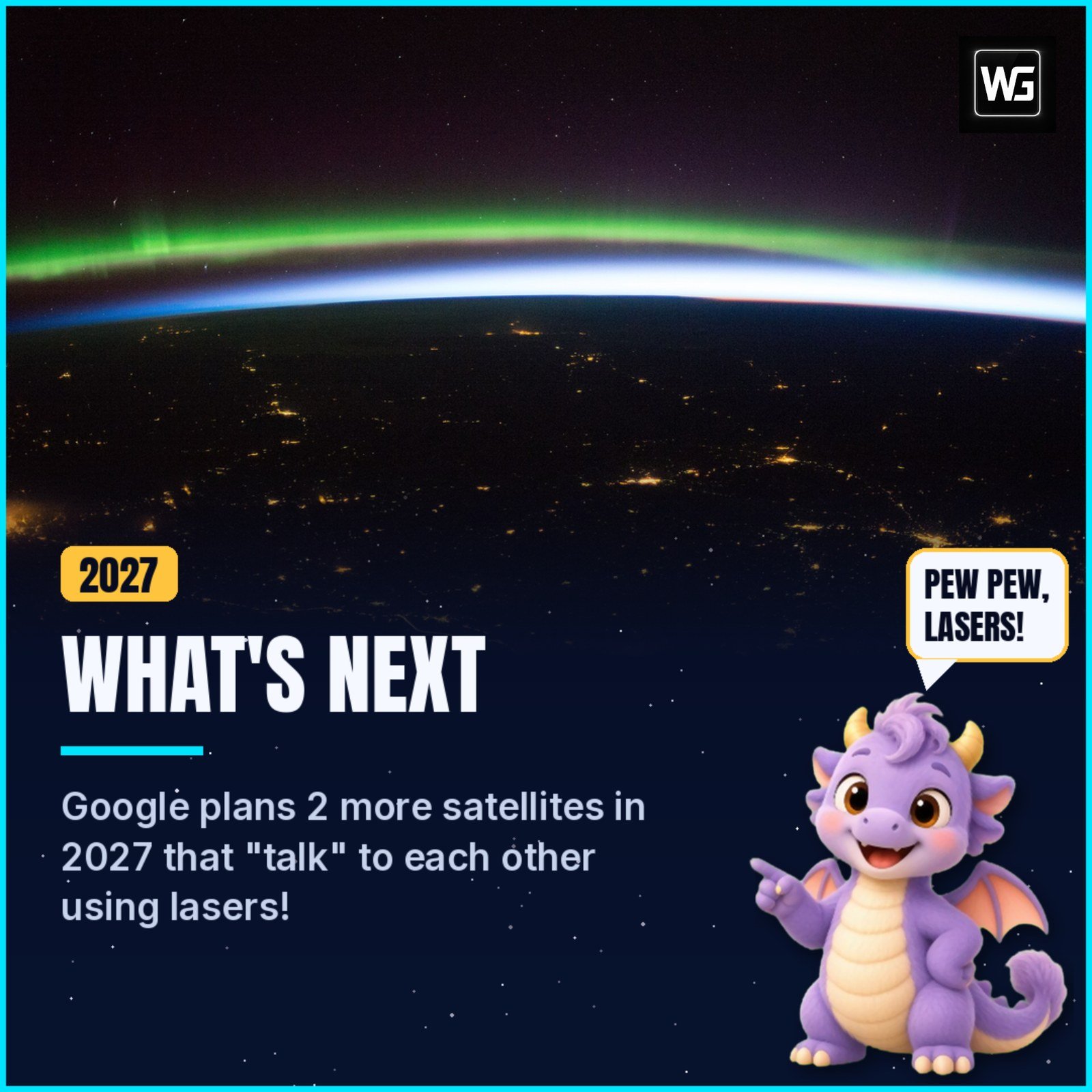
Laser-linked satellites
Google plans to launch two more satellites in 2027 to test how they connect to each other (NPR). In the long run, each satellite would carry dozens of TPUs and use lasers to talk to the others and to Earth.
Fun fact: the original plan was to start with those two custom satellites in 2027. Google sped things up by putting its chips into a satellite Planet had already built (Ars Technica).
Google isn’t alone
- Starcloud, a startup, flew an Nvidia H100 chip in space in November 2025 (NPR).
- SpaceX has announced plans for its own orbital data centers (CNBC).
Will This Actually Work? The Honest Answer
Experts are excited but careful:
- Cost: Launches are expensive, and repairs in orbit are very hard. Carnegie Mellon professor Brandon Lucia says these costs could be “amplified by a factor of 10, maybe a factor of 100” (NPR).
- Environment: Rockets burn fuel, and old satellites can add pollution when they burn up on re-entry.
- Timeline: Beals himself says: “I don’t see this being something where it’s cheaper to do this in the next five years.” He expects space and Earth data centers to coexist for a long time (NPR).
Pip’s take: 🐉 This is a science experiment, not a product (yet). But every big idea starts with one small, brave test. (Moonshots don’t always work, though: read about tech products that failed.)
FAQ: Google Project Suncatcher
What is Google’s Project Suncatcher?
It’s a Google research moonshot exploring whether solar-powered satellites full of AI chips could one day work as data centers in space (Google).
When did the Project Suncatcher satellite launch?
It launched on October 1, 2026, on SpaceX’s Transporter-18 rideshare mission, and Google confirmed it was operating as expected (CNBC).
How many AI chips are on the satellite?
Four of Google’s TPUs (Tensor Processing Units) are inside a refrigerator-sized satellite built with Planet (NPR).
Why do the chips only run for 15 minutes?
Space has no air to carry heat away, so the radiators need time to shed heat. The TPUs run for about 15 minutes, then cool down (Ars Technica).
What comes after this prototype?
Google plans two more satellites in 2027 to test laser links between satellites (NPR).
Will space data centers replace ones on Earth?
Not anytime soon. Google’s project lead expects both to coexist for a long time and doesn’t see space being cheaper within five years (NPR).
Conclusion: A Tiny Satellite With a Giant Idea
Four chips, one fridge-sized satellite and 15-minute work shifts. It sounds small, but it’s the first real step toward AI that runs on sunlight in space. Whether it turns into the future of computing or a cool experiment, we’ll be watching. 🌞🛰️

👉 Follow us on Instagram for simple, fun tech news with Pip the dragon. We’ll share every Suncatcher update as it happens. Follow on Instagram: instagram.com/wireglobally
Photo credits: Falcon 9 Transporter-6 launch: U.S. Space Force photo by Joshua Conti, public domain.
CubeSats ejected from the ISS: NASA Johnson Space Center, public domain.
Google TPU v4 board: Jouppi et al. (Google), CC BY 4.0.
ISS Roll-Out Solar Array: NASA, public domain.
Google TPU 3.0: Zinskauf, CC BY-SA 4.0.
Earth sunrise and aurora from the ISS: NASA, public domain.

